


Ethereum has fallen sharply below the important $3000 support level, extending a decline that now places it roughly forty percent beneath its year to date peak. The downward momentum appears likely to continue in the short term as the chart structure turns increasingly bearish and as Wintermute maintains its aggressive selling activity. Market sentiment has weakened considerably, and the combination of technical and fundamental pressures is amplifying the current downturn.
Large Holders Accelerate Ethereum Selling
The price of ETH has been sliding throughout the week as demand cools and major holders reduce exposure. Wintermute has emerged as one of the most active sellers, unloading millions of dollars worth of tokens in recent weeks. In the past four hours alone, the firm transferred more than $17 million in ETH, raising concerns about the scale of its influence on market direction.
Other major institutions have also contributed to the selling pressure. Several ETF issuers, including BlackRock, Grayscale, Fidelity, and Bitwise, have reduced their Ethereum holdings. Their actions are tied to persistent outflows from spot Ethereum ETFs, which have remained elevated throughout the month. According to data from SoSoValue, spot ETH ETFs have recorded $416 million in outflows this month and more than $1.4 billion in November, reducing cumulative inflows from over $15 billion to $12.5 billion.
Declining Futures Activity Signals Weakening Demand
Ethereum futures open interest has also contracted significantly, falling from more than $60 billion earlier in the year to the current $39 billion. This decline suggests that traders are reducing leverage and stepping back from speculative positions. Seasonal factors, including the Christmas holiday period, have further contributed to reduced trading activity and softer demand.
Despite the negative momentum, Ethereum still has potential catalysts that could support a recovery in the coming months. BitMine continues to accumulate ETH with a long term goal of holding five percent of the total supply and currently controls three point six percent. Ethereum is also benefiting from the recent Fusaka upgrade, which has strengthened its position in decentralized finance and real world asset tokenization. JPMorgan’s decision to use Ethereum for its first onchain money market fund highlights this growing utility.
Technical Outlook Points to Further Downside
On the technical front, Ethereum has been in a steady decline since reaching a record high of $4960 in August. It dropped to $2621 on November twenty first and has since formed a death cross pattern as the 100 day and 200 day exponential moving averages crossed. The price has also fallen below the 50% Fibonacci retracement level and is developing a bearish flag pattern, having already broken below the lower boundary of the channel.
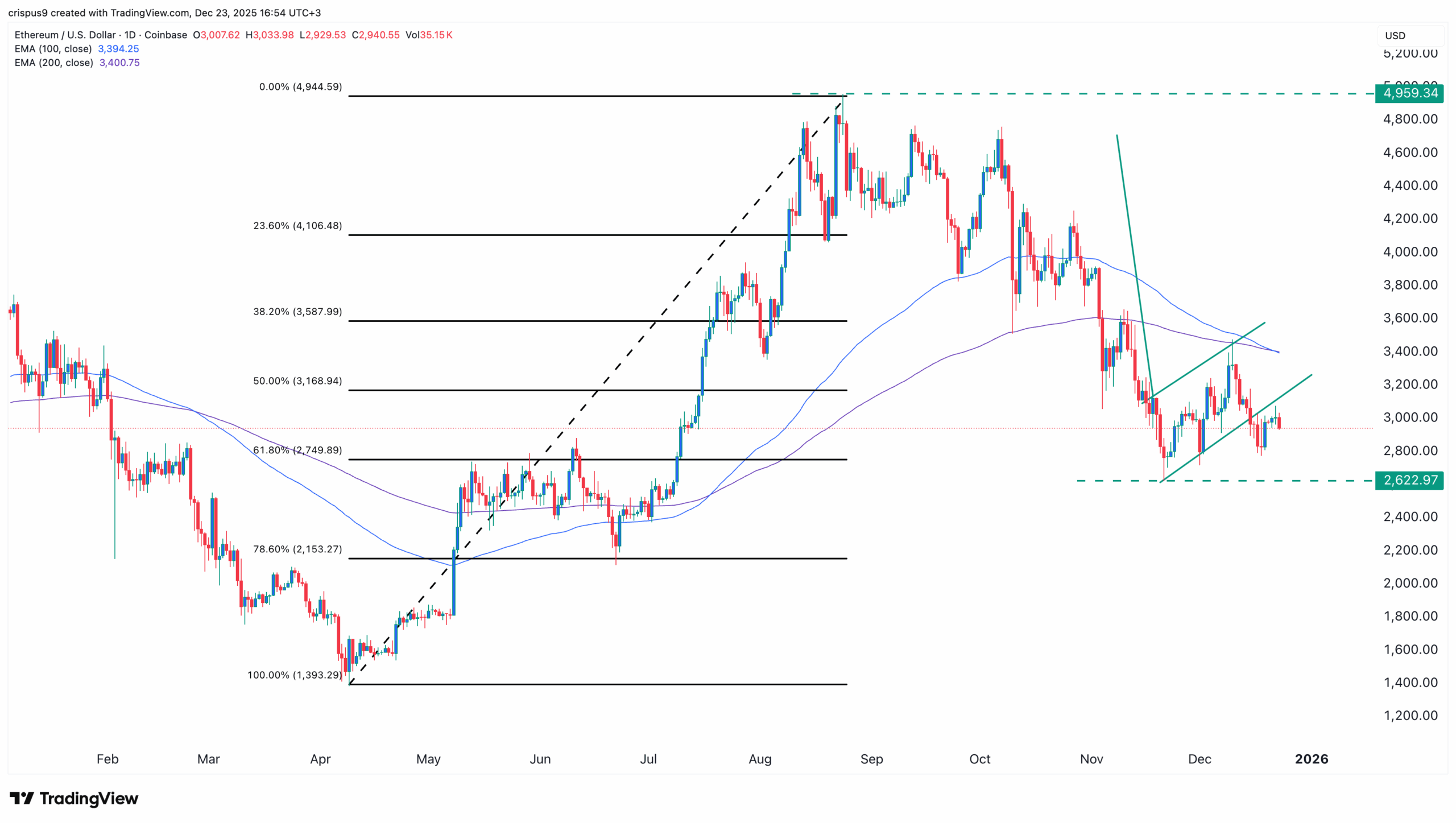
The most probable scenario remains bearish, with an initial target at the November low of $2622. A break below that level could open the path toward the psychological $2500 zone. This outlook would be invalidated only if ETH climbs back above the 200 day moving average near $3400.
Frequently Asked Questions (FAQs)
- What is causing the recent drop in Ethereum price?
The decline is driven by heavy selling from major holders like Wintermute, significant ETF outflows, and weakening demand across both spot and futures markets.
- Could Ethereum recover in the coming months?
A recovery is possible due to factors such as BitMine accumulation, the impact of the Fusaka upgrade, and growing institutional use cases like JPMorgan’s onchain fund.
- What price levels are traders watching now?
Key levels include support at $2622 and the psychological $2500 zone, while resistance sits near the 200 day moving average around $3400.